
14K Gold Hallmark Guide: How to Identify 14K Gold
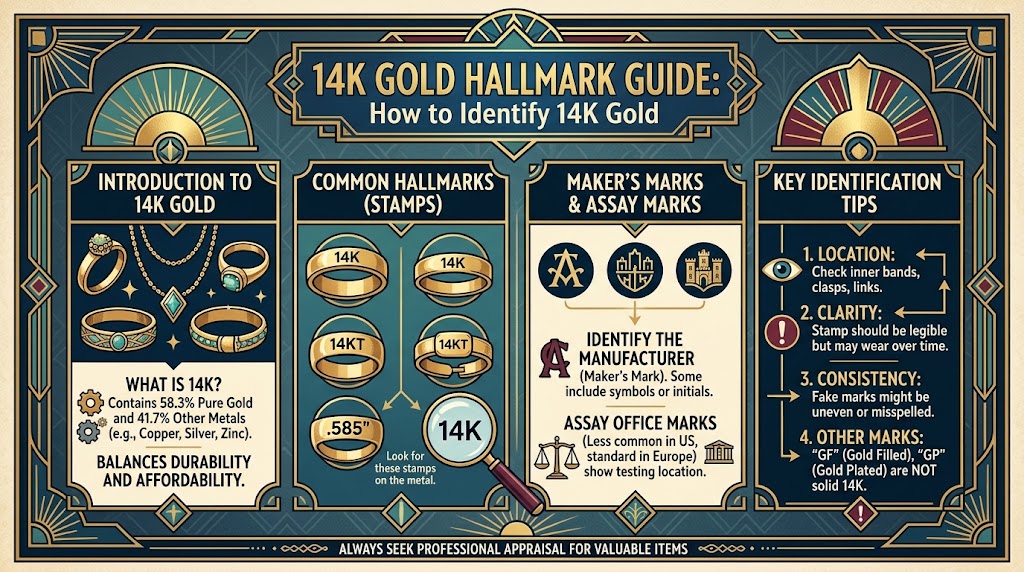
If you own a gold ring, necklace, bracelet, or another piece of jewelry, you may have noticed tiny numbers or letters stamped somewhere on it. These markings are called gold hallmarks, and they can tell you important information about the metal’s purity.
For 14K gold, the most common markings include 14K, 14KT, and 585. But finding a stamp does not automatically guarantee that a piece is genuine gold.
Understanding what these marks mean and knowing where to look can help you identify 14K gold before buying, selling, or valuing a piece of jewelry.
What Is a 14K Gold Hallmark?
A 14K gold hallmark is a stamp or engraving placed on gold jewelry to indicate its purity. The “14K” means the jewelry contains 14 parts pure gold out of 24 parts total metal.
In percentage terms:
14 ÷ 24 × 100 = 58.3% pure gold
Because of this, 14K gold is often marked 585, representing approximately 58.5% gold content.
The remaining metal is usually made up of other alloys, such as silver, copper, zinc, or palladium. These additional metals make the jewelry harder and more durable than higher-purity gold.
Common 14K Gold Hallmark Numbers
You may see several different markings on genuine 14K gold jewelry:
| Mark | Meaning |
|---|---|
| 14K | 14-karat gold |
| 14KT | 14-karat gold |
| 585 | Approximately 58.5% gold |
| 14K GP | Gold plated, not solid 14K gold |
| 14K GF | Gold filled, not solid 14K gold |
The exact marking can vary depending on the country, manufacturer, and type of jewelry.
What Does 14K Mean on Jewelry?
The 14K marking refers to the karat purity of the gold.
Pure gold is considered 24K, but pure gold is relatively soft. Jewelry manufacturers mix gold with other metals to improve strength and durability.
14K gold contains approximately 58.3% pure gold, while the remaining percentage consists of alloy metals.
This makes 14K gold a popular choice for everyday jewelry because it offers a balance between gold content, durability, and price.
Where Can You Find a 14K Gold Stamp?
The hallmark is usually placed somewhere that is visible but doesn’t interfere with the appearance of the jewelry.
For example:
Rings
Check the inside of the ring band. This is one of the most common locations for a gold purity stamp.
You may see something like:
14K
or
585
Necklaces and Bracelets
Look around the clasp or the small metal tag near the clasp.
Because these areas are less noticeable when the jewelry is worn, manufacturers commonly place purity markings there.
Earrings
Check the back or post of the earring. Small earrings may have extremely tiny markings, so a magnifying glass can help.
Pendants
Look at the back or bail of the pendant, particularly around the small loop that connects it to the chain.
14K vs. 585: Are They the Same?
In most cases, 14K and 585 refer to essentially the same gold purity.
The difference is simply the way purity is expressed.
14K uses the karat system, which measures gold out of 24 parts.
585 uses a fineness system, where the number represents parts of pure gold per 1,000 parts of metal.
So:
585 = approximately 58.5% gold
and
14K = approximately 58.3% gold
The tiny difference comes from rounding conventions.
How to Identify 14K Gold
Checking the hallmark is a useful first step, but it should not be your only test.
If you want to identify whether jewelry is actually 14K gold, follow these steps.
1. Look for the Gold Purity Stamp
Start by examining the jewelry for markings such as 14K, 14KT, or 585.
Use a bright light and, if necessary, a magnifying glass because jewelry stamps can become very small or worn over time.
2. Check for Plating or Filled Markings
Pay attention to markings that contain additional letters.
For example, 14K GP generally indicates gold plating rather than solid 14K gold.
Similarly, 14K GF generally means gold-filled jewelry.
These pieces contain gold, but they should not be valued in the same way as solid 14K gold.
3. Examine the Jewelry for Wear
Look closely at areas that receive frequent friction.
If the surface appears to have a different-colored metal underneath, the item may be plated rather than solid gold.
However, appearance alone cannot prove whether gold is genuine.
4. Consider Professional Testing
For an expensive piece of jewelry, professional testing is the safest option.
A jeweler or qualified precious-metal professional can use appropriate testing methods to determine the metal’s composition and purity.
This is especially important when buying second-hand jewelry or selling valuable gold.
Does a 14K Stamp Guarantee Real Gold?
Not necessarily.
A hallmark is a useful clue, but a stamp can be copied or added to counterfeit jewelry. This is why you should not rely on the number alone when determining whether an expensive piece is genuine.
A better approach is to combine:
- The purity marking
- The jewelry’s condition
- The seller’s reputation
- Documentation or receipts
- Professional testing when necessary
If several factors point toward genuine 14K gold, you can have much greater confidence in the piece.
14K Gold Hallmark vs. Gold-Plated Markings
One of the most important things to understand is the difference between solid 14K gold and jewelry that only has a layer of gold on the surface.
Solid 14K gold is made from a metal alloy containing approximately 58.3% pure gold.
Gold-plated jewelry has a different base metal with a thin layer of gold applied to its surface.
Some common markings include:
- 14K — indicates 14-karat gold when legitimately marked
- 585 — approximately 14K purity
- 14K GP — generally gold plated
- 14K GF — generally gold filled
- GEP — generally gold electroplated
These markings matter because two pieces can look almost identical while having very different gold content and value.
Is 14K Gold Good Quality?
Yes. 14K gold is widely used for jewelry because it provides a practical combination of gold content and durability.
Compared with higher-karat gold, 14K gold contains more alloy metals. This generally makes it harder and more suitable for jewelry that is worn regularly.
For people who want genuine gold jewelry that can handle everyday use, 14K gold can be a practical choice.
Does 14K Gold Tarnish?
Pure gold does not easily react with air, but 14K gold contains other metals that can react with the environment.
As a result, 14K jewelry can sometimes become dull or develop surface discoloration over time.
This does not automatically mean the jewelry is fake.
The exact appearance can depend on the alloy used, how often the jewelry is worn, and its exposure to substances such as chemicals, cosmetics, and cleaning products.
Can a 14K Gold Hallmark Wear Off?
Yes.
Jewelry is exposed to friction every day, especially rings and bracelets. Over many years, a small hallmark can become difficult to read.
If you cannot find a clear 14K or 585 stamp, don’t immediately assume the jewelry is fake.
The marking may be:
- Very small
- Hidden inside a clasp
- Partially worn away
- Covered by dirt or residue
- Difficult to see without magnification
Professional testing can help when the hallmark is missing or unreadable.
14K Gold Hallmark and Gold Value
The hallmark can help you determine the approximate purity of a piece, but it does not tell you the exact selling price.
The value of 14K gold depends on several factors, including:
- Current gold price
- Weight of the jewelry
- Gold purity
- Buyer or dealer’s pricing
- Manufacturing or design value
- Condition
- Brand or collectible value
For scrap-gold calculations, the actual gold content is particularly important.
Because 14K gold is approximately 58.3% pure gold, 10 grams of 14K gold contains roughly 5.83 grams of pure gold, before accounting for any non-gold components such as gemstones or other materials.
Final Thoughts
A 14K gold hallmark is one of the easiest places to start when identifying gold jewelry. Markings such as 14K, 14KT, and 585 can indicate that a piece is approximately 14-karat gold.
However, a stamp by itself is not absolute proof of authenticity. Counterfeit jewelry can also carry false markings, while genuine older jewelry may have worn or missing hallmarks.
For valuable jewelry, the best approach is to check the hallmark, examine the piece carefully, and use professional testing when you need certainty.
That way, you can better understand what your jewelry is actually made of before deciding its value or selling it. Also Read: https://goldratecal.com


