
14K Gold vs 10K Gold: Price, Purity, and Durability Compared
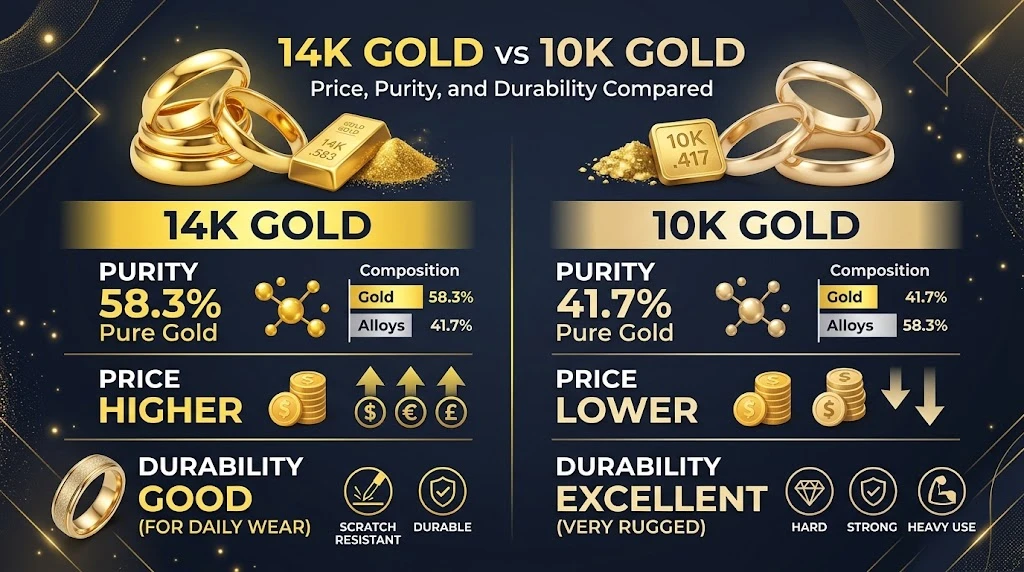
When choosing a gold ring, necklace, bracelet, or another piece of jewelry, you may come across both 10K and 14K gold. They can look very similar, but they are not the same when it comes to gold content, price, color, and durability.
The main difference is simple: 14K gold contains more pure gold than 10K gold. However, that does not automatically make it the better choice for everyone. Your budget, how often you wear the jewelry, and what you want from the piece all matter.
10K Gold vs 14K Gold at a Glance
| Feature | 10K Gold | 14K Gold |
|---|---|---|
| Gold Purity | 41.7% pure gold | 58.3% pure gold |
| Common Hallmark | 10K or 417 | 14K or 585 |
| Gold Content | Lower | Higher |
| Price | Usually more affordable | Usually more expensive |
| Durability | Generally harder | Durable, but slightly softer |
| Color | Usually lighter | Usually warmer and richer |
| Everyday Wear | Excellent | Excellent |
| Intrinsic Gold Value | Lower for the same weight | Higher for the same weight |
| Best For | Budget-friendly, durable jewelry | Higher purity and richer gold appearance |
What Is the Difference Between 10K and 14K Gold?
The “K” in gold karat refers to the amount of pure gold in the metal. Pure gold is 24 karats, so lower-karat gold contains a larger amount of other metals mixed with it.
10K gold is about 41.7% pure gold, while 14K gold is about 58.3% pure gold. The remaining portion is made from metals such as silver, copper, zinc, or other alloys.
This extra gold content is the biggest reason 14K gold usually costs more than 10K gold.
10K Gold vs 14K Gold Purity
If purity is your main concern, 14K gold has the advantage.
10K gold contains 10 parts gold out of 24, giving it a gold purity of approximately 41.7%. It is often marked 10K or 417, with 417 representing its gold content.
14K gold contains 14 parts gold out of 24, which equals approximately 58.3% pure gold. You may see it marked 14K or 585.
So, when comparing only gold content, 14K gold is purer than 10K gold.
Which Is More Expensive: 10K or 14K Gold?
In most cases, 14K gold is more expensive than 10K gold because it contains significantly more pure gold.
For example, if two pieces of jewelry have the same weight and design, the 14K piece will generally have a higher underlying gold value. The exact retail price can still vary because jewelry prices also include labor, design, brand markup, gemstones, and other costs.
This is why you should not judge a piece only by its total price. The karat, weight, and current gold market price all play a role.
Which Is More Durable?
Both 10K and 14K gold are mixed with stronger metals, making them more practical for everyday jewelry than pure 24K gold.
However, 10K gold generally has a slight durability advantage because it contains a higher percentage of harder alloy metals. This can make it a practical option for jewelry that gets a lot of daily wear.
14K gold is also durable enough for everyday rings, bracelets, necklaces, and other jewelry. It simply has a higher gold content, which makes it somewhat softer than 10K gold.
For normal use, both can be good choices when the jewelry is properly cared for.
10K Gold vs 14K Gold Color
The higher gold content in 14K gold can give it a warmer and richer gold appearance.
10K gold usually has a slightly lighter or less warm appearance because more of its composition comes from alloy metals. The exact color can also change depending on which metals are used in the alloy.
This difference is easier to notice when comparing yellow gold pieces side by side.
White gold can look different again because its color depends heavily on the metals used in the alloy and any surface coating applied to the jewelry.
Is 10K Gold Better for Everyday Wear?
10K gold can be a practical choice if you want jewelry that is relatively affordable and able to handle regular use.
Because it contains less pure gold and more alloy metals, it can be harder than 14K gold. That makes it useful for pieces that may experience more contact, scratches, or general wear.
The trade-off is that you are getting less actual gold in the piece.
Is 14K Gold Better for Jewelry?
For many people, 14K gold offers a good middle ground.
It has considerably more gold than 10K gold while still containing enough alloy metals to make it suitable for everyday jewelry. Its color also tends to have a richer gold appearance than lower-karat options.
That combination is one reason 14K gold is commonly used for rings, chains, bracelets, and other jewelry.
10K vs 14K Gold: Which One Should You Choose?
There is no single answer for everyone.
If your priority is lower cost and extra hardness, 10K gold can make sense. It gives you genuine gold content while keeping the price lower than comparable 14K jewelry.
If you want higher gold purity, a richer gold color, and a good balance between purity and durability, 14K gold may be the better option.
Think of it this way:
- 10K gold: Lower gold content, usually lower price, generally harder
- 14K gold: Higher gold content, usually higher price, richer gold color
- Both: Suitable for everyday jewelry when properly cared for
Does 14K Gold Hold More Value Than 10K Gold?
Since 14K gold contains more pure gold, the same weight of 14K gold generally has a higher intrinsic gold value than 10K gold.
However, the amount you could actually receive when selling jewelry can be different from its theoretical gold value. Buyers may consider the item’s condition, weight, current market price, refining costs, and other factors.
So if you are trying to determine what an old ring or necklace is worth, look at its karat, weight, and current gold price rather than assuming the original purchase price represents its current value.
Final Thoughts
The choice between 10K and 14K gold comes down to what matters most to you.
10K gold is a good option when keeping the cost lower and having a harder alloy are important. 14K gold gives you a higher percentage of pure gold while still offering the durability needed for everyday jewelry.
If you already own a piece of gold jewelry, checking its karat mark and weight is a good starting point for understanding its value. From there, the current gold market price can help you estimate the gold content more accurately.

